
The problem with rom-com subversions made by men
The bone I have to pick with 500 Days of Summer and My Best Friend's Wedding

Those of us who love romantic comedy are accustomed to being told that it is a women’s genre. The romantic comedies of early Hollywood weren’t “for women,” necessarily, but they’re certainly made with women in mind today. Audiences of romantic comedy films are primarily women, and their protagonists and biggest stars are women. Every time a big rom-com hits, it’s assumed that any men who see it will have been dragged by their girlfriends and wives, or, if they came willingly, are gay. But despite all this, those helming the romantic comedy film, the directors and writers especially, are so often men.
There’s nothing inherently wrong with this, on an individual basis. I like men!1 I like plenty of romantic comedies that men have made: 13 Going on 30, Moonstruck, When Harry Met Sally. What I have come to be skeptical of is men who decide they want to make a different kind of romantic comedy. They say they’re bored with the classic rom-com format and want to interrogate it differently. What is at the bottom of these tropes that we so romanticize, and how would we react if we saw them play out in reality? What if the girl doesn’t get the guy, or the guy doesn’t get the girl? What if these people are pieces of shit?
These are not unfair questions, but I’m not sure these “subversions” adequately answer them. Two of the most prominent examples of this format — 1997’s My Best Friend’s Wedding and 2009’s (500) Days of Summer, both directed and written by men — depict “trainwreck” women who either reject or aren’t seen as deserving of a traditional happy ending. These films exult in depicting women’s reprehensible behavior, but what they forget, or don’t care to mention, is that it takes two to tango. And someone has to dance the man’s part.
There was a very specific period of time on the Internet — sometime in the late 2010s, just as the traditional romantic comedy film was losing its grip on theatergoers — when everyone was claiming to know The Truth about (500) Days of Summer. The twee, postmodern-leaning bildungsroman, starring Joseph Gordon-Levitt and Zooey Deschanel, tells an anti-love story: Tom, a hopeless romantic, tries to convince Summer, a cynic and relationship anarchist, that she is his one true love, with disastrous results. The Truth that I saw so many people proclaiming was that everyone had gotten the film wrong when it first came out. Summer, who did nothing but clearly state her relationship preferences, was not the villain of the film: Tom, who tried to manipulate her into feeling otherwise, was.
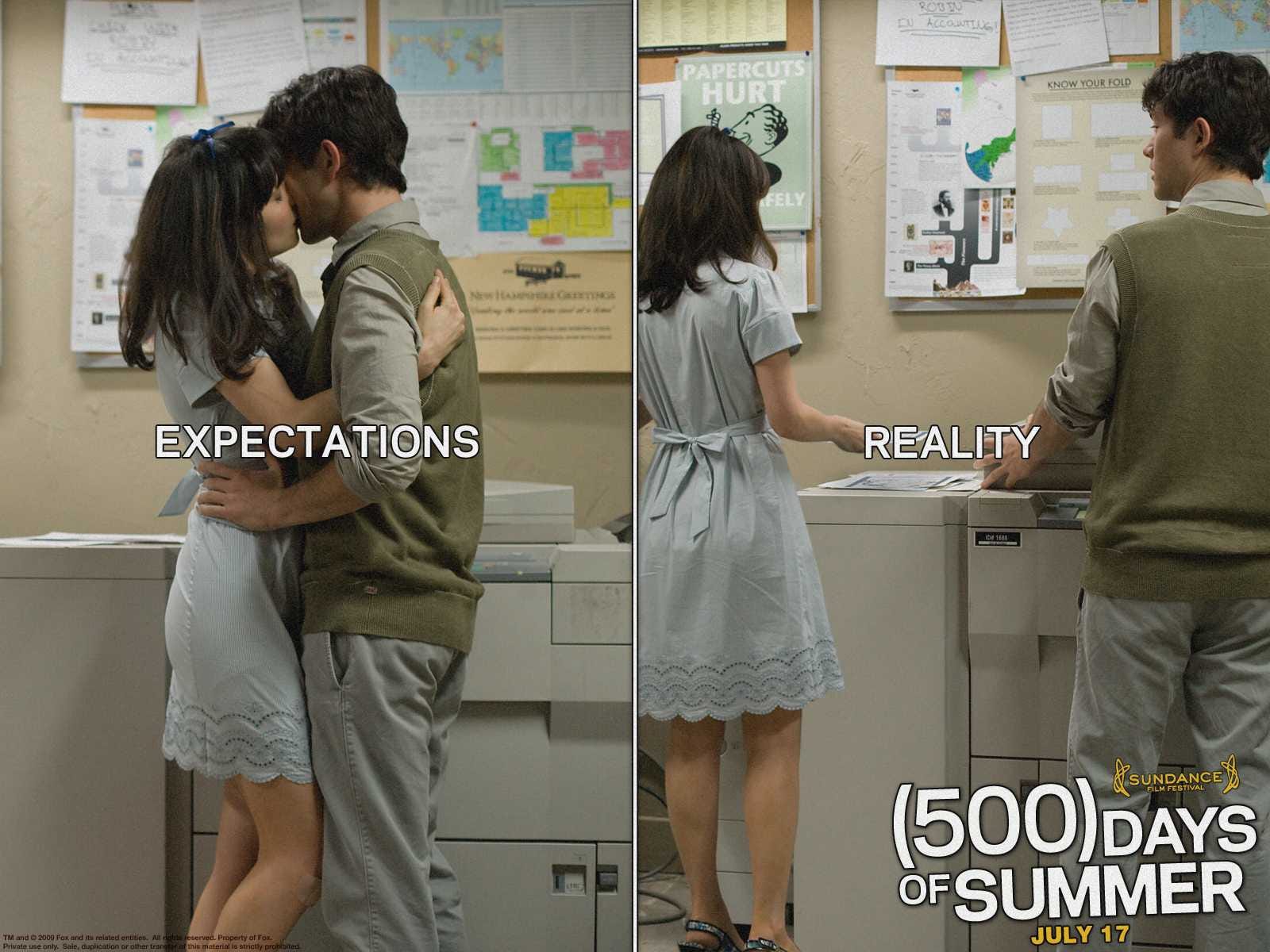
This narrative of a woman expressing herself honestly and a man overriding her wishes feels familiar and satisfying, a reading of the film that felt comfortable in the #MeToo era. It’s not a wholly incorrect interpretation, but it didn’t match my own feelings about (500) Days. Something about Summer’s characterization, the cavalier way she dealt with other people’s feelings, had always made my skin crawl, but then again, I was a teen at the time I first watched the film. Upon rewatching (500) Days more recently, I enjoyed it much more, and I sympathized with Summer much more, but I didn’t come away believing she was innocent. If Tom is controlling, Summer is painfully avoidant: she's bad at setting or respecting boundaries, and especially near the end, she withholds information from Tom, specifically that she’s now partnered and later gets engaged. Her only defense when he confronts her about this is along the lines of, “Well, he hadn’t asked me yet.”
Part of me wants to give the film credit for this nuance. Contrary to what the Internet would like to believe, failed relationships are rarely composed of one perfect person and one horrible person; it’s usually two flawed people rubbing up against each other. But the more I learned about screenwriter Scott Neustadter’s inspiration for his script, the less charitably I viewed his interpretation of Summer. According to Neustadter, about 75 percent of his screenplay for (500) Days was based a past relationship with a woman named Jenny Beckman. Beckman’s name (which may or may not be her real one; Neustadter has never confirmed this) even appears onscreen at the beginning of the film:
AUTHOR’S NOTE: The following is a work of fiction. Any resemblance to persons living or dead is strictly coincidental.
Especially you Jenny Beckman.
Bitch.
Arguments abound on whether this message is purposely vindictive or simply ironic, meant to trick viewers into sympathizing with Tom before revealing the narrow-mindedness of his perspective. But somehow, what strikes me most about this message is the punctuation. Why isn’t there a comma after “you” and before “Jenny?” You’re probably convinced I’m overthinking this — and yes, perhaps my inner pedant, long-stifled in favor of keeping my friendships intact, is responsible for this rumination — but it’s notable because (500) Days of Summer is otherwise such a detail-oriented film. It manages to keep track of 500 days worth of time jumps, skipping from day 2 to day 200 to day 20. It assigns Summer a signature color, blue, that other actors don’t wear. It even, annoyingly, stylizes its title with parentheses around the “500.” So how, in such a carefully planned project, did this omitted comma in the opening shot get past an editor? The sloppy, eighth-grade-bathroom-wall vibe of this statement could be purposeful, a manifestation of Tom’s petulance and immaturity. Or maybe it’s an indication that the movie isn’t as meticulously thought out as it seems to be, that the different facets of the film aren’t really talking to each other — and, perhaps, neither were the different men working on it.
For example, there’s a striking contrast between how Neustadter talked about this film when it first came out and how he began to talk about it years later. Shortly after the movie’s release, Neustadter said in an interview that he and Jenny Beckman met up again for coffee while he was working on the (500) Days script, which he shared with her. She emailed him to tell him how much she identified not with Summer, the character she was based on, but with Tom. This detail, which on its own could have been the impetus for a brilliant movie, fails to resonate with Neustadter, who merely seems annoyed to find his ex-girlfriend capable of interiority that clashes with his own. But in interviews from a few years later, Neustadter speaks about the film the way 2010s indie-twee lovers did, as the coming-of-age tale of a man who learns he can’t control a woman. Neustadter might have genuinely grown as a person in this period of time, but he might also have realized that the Internet would crucify him if he didn’t change his tune. It’s possible that director Marc Webb and star Joseph Gordon-Levitt pushed Neustadter closer to this conclusion; both spoke critically of Tom’s character well before Neustadter did. Their influence over the film may be why so many viewers perceive Tom as intentionally unlikable, and they probably did save Neustadter’s reputation: in the hands of a different director or star, this film probably would have appealed to incels even more than it already does.
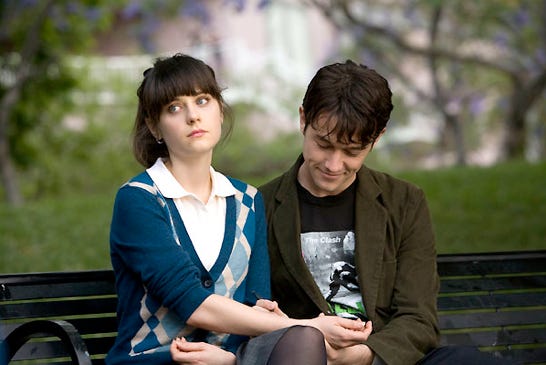
But even a well-meaning director and star cannot force an underwritten character into dimensionality, and so it is with Summer. If you’re a fan of the movie, you've probably insisted that Summer’s flatness, the way her character is distilled down to childhood trauma and a love for The Smiths, is the whole point — the John Green Defense, as I like to call it, the idea that a well-meaning male author who knows he can’t write women can avoid criticism by having the text acknowledge these women’s lack of depth. However, this technique never actually results in better-written women, and it was certainly never going to here, because Summer was written by a man who resented her. Or, at the very least, he resented what she represented. Zooey Deschanel didn’t have a fighting chance.
Unlike (500) Days of Summer, 1997’s My Best Friend’s Wedding is primarily about a woman. But that woman wasn’t created by women. Directed by PJ Hogan, the movie follows Julianne, or Jules (played by Julia Roberts), a woman so convinced she has a right to the heart of her “best friend,” a guy she rejected years ago, that she sabotages his wedding and relationship with his fiancée to prove it. Ron Bass, who wrote the script, wanted to comment on the unhinged behavior that’s so often handwaved in classic romantic comedies, especially, in his and Hogan’s view, from women. Scott Meslow’s book From Hollywood With Love: The Rise and Fall (and Rise Again) of the Romantic Comedy describes Hogan’s initial reaction to Ron Bass’s script:
… usually in romantic comedies, everything the main character does in order to win love and to find happiness is totally justified. Even if it’s kind of awful. What Meg Ryan does to Bill Pullman in Sleepless in Seattle is kind of awful … And I got to the end, and she didn’t get the guy. And I thought, Oh, my God, that’s the point. This takes the form and smashes it on the floor.
My Best Friend’s Wedding challenges audiences’ expectations for romantic comedies at every turn. It casts Julia Roberts, queen of the 1990s rom-com, in the deeply unlikable role of Jules. It sets us up to hate Kimmy, Jules’s friend Michael’s 20-year-old fiancée, only to give us a sweet, winning character played by Cameron Diaz at her most effervescent. It teases viewers with musical numbers that nod at bucolic, Disneyfied romantic ideals, only to contrast them with increasingly psychotic behavior from Jules: forcing Kimmy to humiliate herself in karaoke, wheedling Kimmy into asking Michael to give up his journalism job, even hacking into Kimmy’s dad’s email account to try to get Michael fired. And, of course, it doesn’t have Jules get the guy after all, because, as it makes pains to tell us, she doesn’t deserve him, and anyway, he doesn’t love her. Right?

Despite its many innovations, I have never been able to like My Best Friend’s Wedding, and this is why: it is so concerned with tearing down a terrible woman that it ignores the terrible man staring us all in the face. Michael, played by Dermot Mulroney, is laughably unconvincing as a man in love who has completely forgotten about his college ex. What’s more, the movie depends on Michael’s manipulative tendencies, because most of Jules’s own behavior is a response (a deeply disordered response, but still a response) to the mixed signals she’s getting from Michael. He flirts with Jules shamelessly (including one time when he says she still looks good in underwear — yikes), alludes to their past as lovers multiple times, and practically begs her to reveal her true feelings while they’re on a riverboat, gazing tragically down into the water when she doesn’t respond. It’s also not just Jules that Michael manipulates; his behavior toward Kimmy, his much-younger fiancee, is domineering at best and downright abusive at worst. Julianne may not be playing fair, but when Kimmy suggests Michael quit his job after she’s already left college for him, no one forces Michael to scream in her face. He does that all on his own.
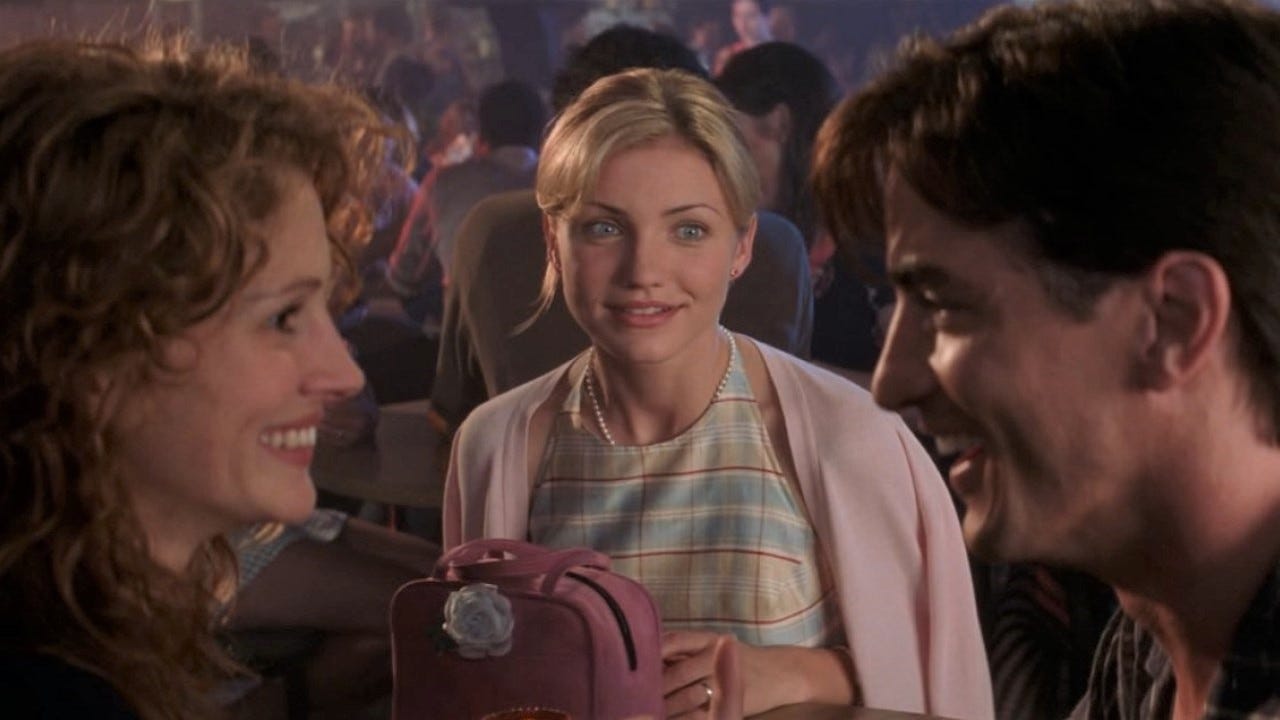
What really gets me is that My Best Friend’s Wedding could have worked without having to write Michael this way. Many lovers of the movie point out the brilliance of its karaoke scene, in which Jules convinces tone-deaf Kimmy to sing karaoke hoping she’ll be humiliated, but Kimmy bellows her song with such gusto that Michael is even more enamored with her than before and even Jules is impressed. I think I know why this scene is such a favorite: it’s not tainted by Michael’s emotional cheating and lack of boundaries. This is the one scene that pulls off what the whole movie is supposedly about: a woman schemes to steal her supposed best friend’s heart, but because he loves someone else and not her, it doesn’t work. If Jules were less successful in provoking Michael’s ire and got less encouragement of her feelings from him, if everything she did only served to make Michael happier with Kimmy and less interested in her, My Best Friend’s Wedding would be a better movie.
But my opinion is apparently in the minority. Viewers of My Best Friend’s Wedding constantly ignore Michael’s shortcomings in favor of Julianne’s, going all the way back to when the movie was first made. Meslow’s book describes test audiences’ disgust at the original ending, which involved Julianne getting wooed by a handsome man played by John Corbett: “One woman suggested that Julianne deserved to be alone forever. A man said that if either of his two daughters acted like Julianne had acted, he’d kick them out of his house.” What did these people say about Michael? If they said anything, the book doesn’t mention it.
In the My Best Friend’s Wedding episode of film podcast The Bechdel Cast, one of the few sources I found that corroborates my opinion of Michael, Jamie Loftus offers some insight on why it is that Julianne’s wrongdoing receives so much more focus than Michael’s:
I am not upset that Julianne was called out for her behavior; I think that makes narrative sense. I do think that most men in that same role and position would not have to answer for this so severely. And I don’t think that a man in this character’s position would have to meaningfully apologize … if we’re putting a woman in the villain role, she’s going to have to spend the last 15 minutes eating shit at unprecedented rates. Where, you know, if you put in Freddie Prinze Jr., he’s like, “Yeah, so I’ve been lying to you and that’s why your life sucks. Do you want to be my girlfriend?”
I was surprised to learn from Meslow’s book2 that despite how anti-woman My Best Friend’s Wedding can be, it did in fact have a team of (uncredited) women writers. In many of his screenwriting projects, including My Best Friend’s Wedding, Bass worked with a group of young female creative consultants, which he dubbed “the Ronettes.” Hogan commented that “[Ron] was certainly not lacking for the female perspective on that screenplay.” So, then, how did a writers’ room full of women produce a character as appalling as Michael? I can think of two explanations. One is that we can’t know much power the Ronettes actually exercised over character development, since Hogan also mentions feeling nervous to discuss the script in front of so many people and asking to speak to Bass alone. The other is that, well, this movie was made 30 years ago, when neither men nor women felt as uncomfortable with men’s moral transgressions as they did women’s. We’re more likely to call attention to the difference today, but honestly, I don’t think much has changed.
In order to subvert a genre, you have to do three things. First, you have to understand what the genre is doing, at its core. Then, you have to have a what-if question that turns certain audience expectations on their heads. Finally — and this is the tricky part — you have to understand the difference between exploring the question and injecting it with your own personal biases.
This is my problem with (500) Days of Summer and My Best Friend’s Wedding. The initial question they both ask, something akin to “What if one person in a romantic comedy doesn’t think they’re meant to be with the other?” is an adequate place to start. But because we live in a culture where hatred of women is the law of the land, and, yes, because both these films were made primarily by men, the message we end up with is more like, “What if a woman behaves almost as badly as the man she’s with? Wouldn’t that be disgusting?” This type of interrogation is, of course, sexist. But it’s also not all that interesting. Being subversive requires doing something novel, and humiliating women isn’t novel at all. We’ve been doing it for way too long for that to be the case.
And yes, after the response to my Neil Gaiman post last year, I do feel the need to spell this out.
Despite my misgivings about My Best Friend’s Wedding as a movie, I really do like and recommend Meslow’s book!
This is so good, though I have blessedly seen neither movie. The desire to be "subversive" so often is a mask for a particular type of male ugliness towards women
I’ve done my “old guy” rant on both of these pictures, and I much prefer “500 Days of Summer” despite my mixed feelings on the Summer character. I’ve been Tom in a couple of relationships and while it’s a painful lesson to learn, setting and managing expectations is a life skill best acquired early in life. This is the hopeful message of the film. That and the chance that there are always Autumns (and Toms) in the world for us to discover if we carry on.